
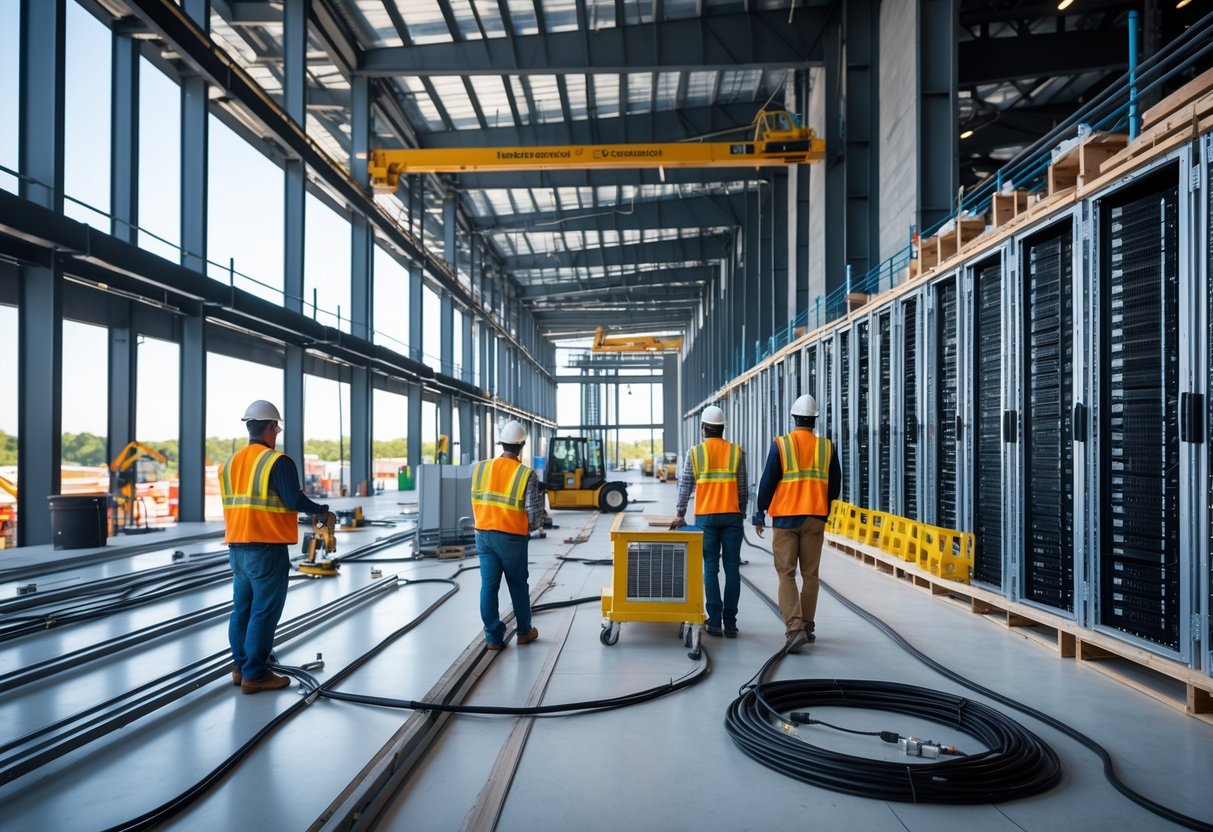
The global landscape of digital infrastructure is undergoing a radical transformation. Beneath the intangible veneer of cloud computing and artificial intelligence lies a physical reality of steel, concrete, and copper. Across the globe, from the foothills of Northern Virginia to the developing digital hubs in Southeast Asia, an unprecedented construction frenzy is taking place. This is the era of the data center construction boom a multi-trillion-dollar industrial expansion that serves as the backbone of the 21st-century economy. However, while this surge in development brings immense opportunity, it is also fraught with complex challenges ranging from energy sovereignty and material volatility to environmental sustainability and community resistance. This article explores the multifaceted dimensions of this construction boom, examining the financial supercycle, technical risks, sustainability imperatives, and the geopolitical shifts shaping the future of how we build the internet.
The Trillion-Dollar Supercycle: Scale and Capital Mobilization
The numbers defining the current data center construction market are staggering in their magnitude. According to market research cited by Allianz Commercial, global spending on data centers is projected to reach up to $7 trillion by 2030, a figure driven predominantly by technology behemoths in the United States and China . This is not merely a period of steady growth; industry analysts at JLL have classified the current climate as an “infrastructure investment supercycle.” To meet projected demands, JLL estimates that nearly 100 gigawatts (GW) of new data center capacity must come online between 2026 and 2030. Financing this expansion requires a complex blend of capital, including approximately $1.2 trillion in real estate asset value creation, $870 billion in new debt financing, and up to $2 trillion allocated for tenant IT fit-outs encompassing advanced GPUs and networking equipment .
The cost profile of individual facilities has undergone a dramatic escalation. Historically, a large data center project might command a price tag of $200 million to $300 million. Today, industry experts note that average-sized facilities now range between $500 million and $2 billion, with the largest hyperscale campuses exceeding $20 billion . These campuses are no longer single buildings; they are sprawling industrial cities housing tens of thousands of servers, requiring the coordination of upwards of tens of thousands of construction workers on site during peak development phases .
This surge is quantified in recent construction start data. ConstructConnect reports that data center construction spending has “surged fivefold in two years.” In November 2025 alone, 22 data center projects broke ground, representing $9.8 billion in new starts a figure nearly four times the total for the same month in the prior year . By the end of 2025, the global data center construction market was valued at $36.38 billion, with projections indicating steady growth to over $100 billion by 2035 .
Primary Drivers: Hyperscalers and the Insatiable Demand for AI
While traditional data centers supported enterprise IT and email servers, the current boom is fueled by distinctly modern workloads. The “big three” cloud providers Amazon, Microsoft, and Google Cloud accounted for nearly two-thirds of global cloud revenue in Q2 2025. When combined with Chinese giants like Alibaba and Tencent, their capital expenditure budgets for 2025 reached hundreds of billions of dollars, much of it allocated to industrial-scale infrastructure capable of supporting high-performance AI .
Artificial intelligence fundamentally alters the construction requirements of a data center. Unlike standard computing, AI workloads involve massive parallel processing, which generates extreme heat and requires dense, high-power server racks. According to the International Energy Agency (IEA), a typical AI-oriented data center consumes as much electricity as 100,000 households. By 2027, AI is expected to account for 28% of the global data center market, more than doubling its current share . This shift forces developers to design facilities with significantly higher power densities, advanced cooling solutions, and robust electrical redundancy.
Navigating the Choppy Waters of 2026: Financial and Logistical Hurdles
Despite the inflow of record capital, the path to project completion is far from smooth. The year 2026 presents a “choppy” market defined by tight timelines and elevated barriers to entry . One of the most pressing issues is the speed at which capital must be deployed. Developers now face immense pressure from utilities, which are overwhelmed by the volume of load impact studies. Utilities have implemented “shot clocks” often 60 to 90 days requiring massive deposits to secure grid connections. This forces developers to source equity financing earlier in the cycle, often before power procurement is even confirmed. Consequently, developers risk diluting their equity or losing control of projects to institutional investors who can write checks for hundreds of millions of dollars upfront .
This environment is driving significant mergers and acquisitions (M&A) and recapitalization activity. JLL predicts that the wave of consolidation, which has already seen $300 billion flow through M&A channels, will shift toward recapitalizations and PropCo joint ventures. A prime example is the $40 billion acquisition of Aligned Data Centers by BlackRock’s Global Infrastructure Partners (GIP). Such moves allow early entrants to exit positions and unlock capital for new developments, but they also signal a market where scale is becoming a prerequisite for survival .
The Material Squeeze: Metals, Tariffs, and Margin Erosion
As construction activity intensifies, the demand for raw materials has created significant price volatility. Data centers are voracious consumers of specific metals: steel for structural frameworks, aluminum for building envelopes, and copper for electrical systems, busways, and grounding .
Entering 2026, contractors are facing a “perfect storm” of mounting cost pressures. While general construction inflation has cooled from pandemic peaks, metals tied to infrastructure and industrial work remain stubbornly expensive. Tariffs on steel and aluminum mill products, particularly in the U.S., have pushed producer price indices higher. Simultaneously, global decarbonization policies and the broad electrification of transport and industry are absorbing massive amounts of global production capacity for copper and aluminum .
According to ConstructConnect Chief Economist Michael Guckes, approximately 70% of a typical project’s expenses are increasing substantially faster than bid prices. This represents the third major margin squeeze in a decade. In response, contractors are shortening bid validity windows, introducing escalation clauses, and locking in material purchases far earlier in the preconstruction phase. Smaller contractors are adapting by focusing on niche markets, modular systems, or subcontracting roles that fall outside the scope of mega-contractors .
The Power Predicament: Grid Capacity and Energy Sovereignty

Perhaps the single greatest threat to the data center construction boom is the availability of electricity. The IEA projects that global electricity demand from data centers will more than double by 2030, reaching approximately 945 terawatt-hours (TWh) slightly more than the entire current consumption of Japan .
This soaring demand threatens to outpace grid capacity. In many mature markets, utilities are struggling to keep pace. Reports indicate that 44% of projects face delays due to grid access limitations . To circumvent this, operators are increasingly pursuing strategies of energy sovereignty. Rather than relying solely on overtaxed public grids, developers are incorporating on-site power generation. This includes traditional gas generators, renewable installations paired with battery storage, and, notably, exploratory interest in small modular nuclear reactors (SMRs) .
This shift has a direct impact on construction scope. Projects are no longer just buildings; they are integrated power infrastructure sites. ConstructConnect notes that power infrastructure starts, which dipped in 2025, are expected to rebound to $27.8 billion in 2026, reflecting the symbiotic relationship between data halls and energy generation .
Unique Risk Profiles: Fire, Water, and Faulty Workmanship
The complexity of modern data center construction introduces a unique risk profile that challenges traditional insurance and construction management paradigms. Electrical issues are the primary source of impactful outages, accounting for 45% of incidents . However, new risks are emerging. The widespread adoption of lithium-ion batteries for UPS (uninterruptible power supply) systems and within server racks introduces significant fire hazards. The thermal runaway potential of these batteries is well-documented in the electric vehicle sector, and data centers now face similar exposure .
Furthermore, the sheer scale of these projects increases the probability of human error. With tens of thousands of workers on-site, faulty workmanship during the installation of complex electrical or cooling systems can lead to catastrophic losses and costly delays. This complexity demands specialized, project-specific insurance policies that cover the construction phase and extend into operations, including provisions for business interruption .
The Sustainability Paradox: Balancing Digital Growth with Net Zero
As the digital economy expands, so too does its environmental footprint. Data centers currently account for approximately 1.5% of global electricity consumption, a figure expected to double by 2030 . This growth trajectory presents a direct challenge to global climate goals.
A report from Ramboll, “Developing sustainable data centres,” emphasizes that the environmental impact is not limited to operational energy. Embodied carbon the emissions associated with the manufacturing and installation of construction materials is a critical concern. The extensive use of reinforced concrete, structural steel, and glass leaves a significant carbon footprint before a single server is ever powered on .
To address this, the industry is shifting toward low-carbon concrete, recycled steel, and local sourcing strategies. There is also a push for circularity, aiming for data centers to ensure all materials are reusable or recyclable, achieving zero output to landfill. Approximately 46% of current construction strategies are now influenced by sustainability initiatives .
A. Water Scarcity and Cooling Innovation
Water consumption is one of the most acute environmental and community relation challenges. Large data centers can consume up to 19 million liters of water per day equivalent to the domestic water use of a town of 50,000 people . This is particularly problematic in water-stressed regions like the American Southwest.
In response, the industry is rapidly pivoting away from traditional evaporative cooling. Air-based closed-loop systems, liquid immersion cooling, and recycled water systems are gaining traction. In Georgia, a Google data center utilizes treated wastewater for cooling before returning it to the river system . The goal of Water Usage Effectiveness (WUE) is becoming as standardized as Power Usage Effectiveness (PUE) .
B. Waste Heat as a Resource
Historically, the heat generated by servers has been viewed as a waste product released into the atmosphere. The sustainability roadmap now reframes this as a valuable asset. Data centers are uniquely positioned to export this thermal energy to district heating systems, warming nearby homes, offices, or agricultural facilities. This approach supports circularity and provides an additional revenue stream while mitigating the facility’s environmental impact .
Social License and Community Resistance
A significant and often underestimated headwind to the data center construction boom is the erosion of social license. In the United States and Europe, local communities are increasingly pushing back against proposed developments. A notable case occurred in Franklin, Indiana, where residents successfully blocked a Google data center rezoning effort. Concerns cited included excessive water and electricity consumption, noise, light pollution, and a perceived lack of tangible local benefits such as high-paying permanent jobs .
This phenomenon is reshaping site selection strategies. While Northern Virginia’s “Data Center Alley” remains dominant, developers are exploring secondary markets in the Midwest, Las Vegas, and Texas. However, even these regions are seeing heightened scrutiny. Analysts suggest that local opposition is the “most overlooked potential outcome” of the current boom, capable of slowing development or distributing it in fragmented regional patterns .
For construction firms and developers, this necessitates a new focus on community engagement and benefit-sharing. Transparency regarding water and energy usage, investments in local infrastructure, and credible commitments to sustainability are no longer optional; they are prerequisites for securing permits and maintaining reputational capital.
Regional Dynamics: A Tale of Three Markets
The data center construction boom is not monolithic; it varies significantly by geography.
North America remains the largest market, projected to cover approximately two-thirds of global power demand for data centers, reaching 81 GW by 2028. The U.S. market is characterized by hyperscale build-outs and significant M&A activity . Canada is also seeing increased activity, particularly in sustainable design initiatives .
Asia Pacific is the fastest-growing region, with a projected compound annual growth rate of 21% from 2024 to 2028. China, Japan, and India currently account for 60% of the region’s installed capacity, but the next wave of growth is expected in emerging economies like Malaysia, Indonesia, and India. These markets are attracting massive platform investments, including a notable $1.6 billion commitment . However, the region also faces distinct challenges regarding grid stability, ecosystem impact (such as heated water discharge affecting aquatic life), and varying regulatory landscapes .
Europe is trailing the US and China but is experiencing a 43% annual increase in pipeline activity. London, Dublin, Amsterdam, Frankfurt, Paris, and Milan are the primary hubs. However, Europe’s aggressive energy regulations and carbon caps are forcing developers to prioritize efficiency and heat reuse earlier in the design process .
Opportunities in Modularity and Edge Computing
Despite the dominance of hyperscalers, the construction market is not exclusively reserved for mega-projects. There is significant headroom for smaller developers and innovative construction methodologies. JLL projects that annual sales of modular systems and micro data centers could reach $48 billion by 2030 .
The rise of edge computing is a primary catalyst here. As applications like autonomous vehicles, smart cities, and IoT devices require real-time processing with minimal latency, data processing must move closer to the end-user. This necessitates the construction of numerous smaller facilities distributed across regions rather than concentrated in massive campuses. Approximately 54% of enterprises now prefer localized data processing, driving demand for flexible, scalable, and rapidly deployable building models .
Modular construction whereby data hall components are prefabricated off-site and assembled on location offers distinct advantages: reduced on-site labor requirements, shorter construction schedules, and minimized material waste. It is estimated that 58% of new facilities are now considering modular design principles to lower deployment complexity .
The Workforce Gap: Skilled Labor Shortages
Executing this volume of complex construction requires a specialized workforce. However, the industry is facing a critical shortage of skilled labor. Approximately 58% of construction firms report difficulty finding qualified electrical and mechanical professionals capable of installing and commissioning high-voltage systems, advanced cooling plants, and sophisticated fire suppression systems .
This shortage creates scheduling risks for nearly half of all projects. As the baby boomer generation retires, the knowledge transfer gap widens. Contractors are increasingly investing in internal training programs and digital tools to augment limited human resources. Building Information Modeling (BIM), AI-assisted project management, and automated commissioning processes are being deployed to maintain productivity targets .
The Future Trajectory: Bubble or Sustainable Growth?
A critical question looming over the industry is whether this breakneck pace is sustainable. Experts at Allianz Commercial note that while there are currently no clear signs the growth has peaked, there are legitimate fears of a bubble .
The trajectory of future AI demand is difficult to gauge. Rapid technological advances may yield efficiencies that reduce the computing power required for specific tasks, or conversely, they may unlock new applications that demand exponentially more resources. The risk of stranded assets facilities rendered obsolete by technological shifts or unable to secure affordable power is a genuine concern for investors and insurers.
To mitigate this, the industry is focusing on future-proofing. New facilities are being designed with higher tolerances for power density and liquid cooling readiness, even if those features are not immediately utilized. Approximately 51% of new builds prioritize long-term scalability to adapt to unknown future digital workloads .
Conclusion: Building the Invisible City
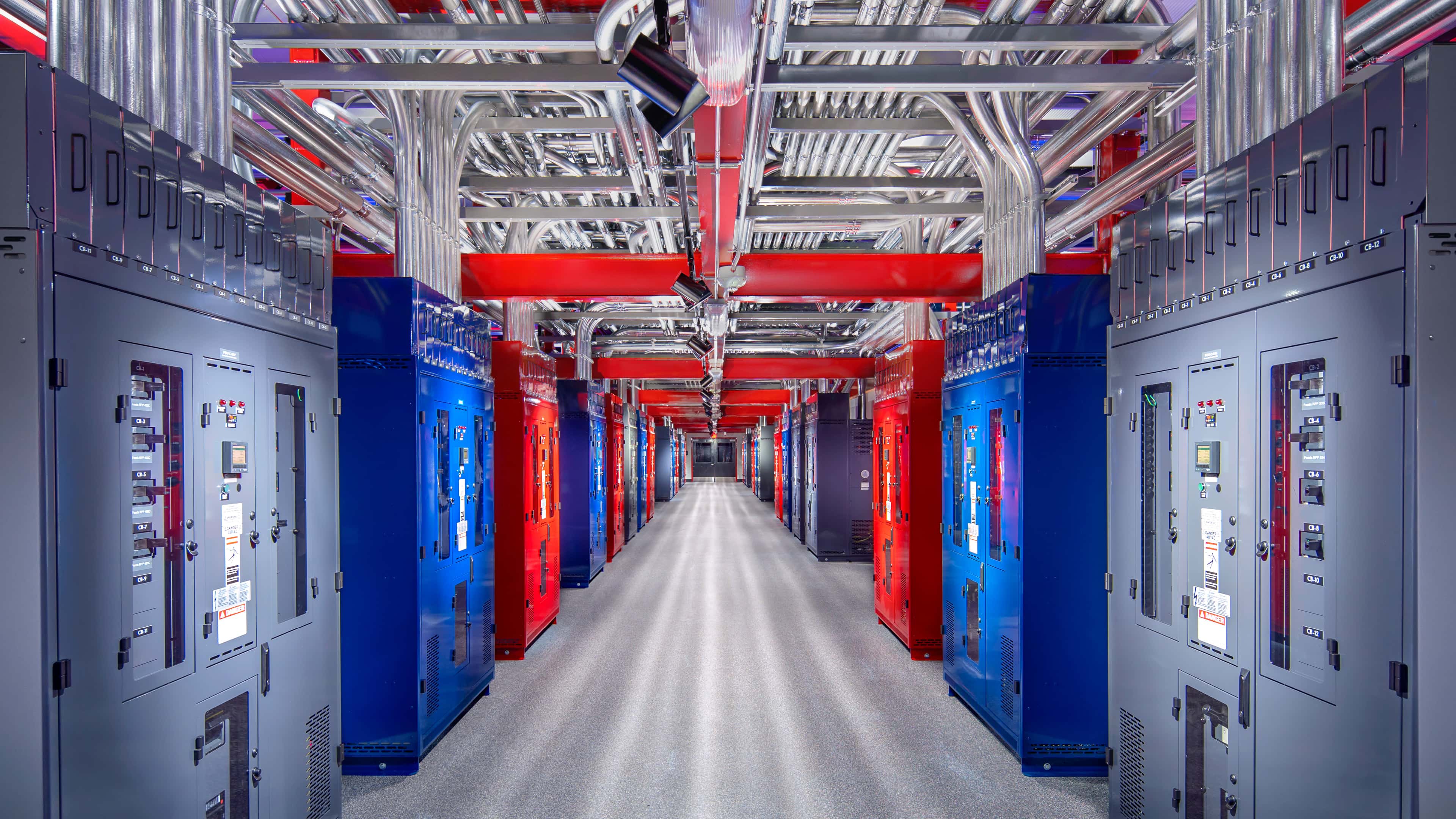
The data center construction boom is far more than a niche segment of the commercial real estate market; it is the physical manifestation of the global transition to an AI-driven, cloud-dependent economy. It represents a convergence of high finance, advanced engineering, environmental science, and public policy.
For construction professionals, this boom offers unprecedented opportunities but demands new competencies. Success in 2026 and beyond requires more than the ability to pour concrete and bend conduit. It requires mastery of supply chain resilience, early-stage capital structuring, utility diplomacy, and rigorous sustainability accounting.
The industry is currently navigating a delicate balancing act. On one hand, it must deliver the digital infrastructure that powers modern life at an unprecedented velocity. On the other, it must address the legitimate environmental and social concerns of the communities hosting these facilities. The developers and contractors who thrive will be those who view power constraints, material volatility, and community expectations not as obstacles, but as design parameters.
As the line between the physical and digital worlds continues to blur, the data center stands as the great mediator. The construction cranes dotting the landscapes of Virginia, Beijing, Dublin, and Johor are building more than server farms; they are erecting the invisible city upon which our collective digital future depends.